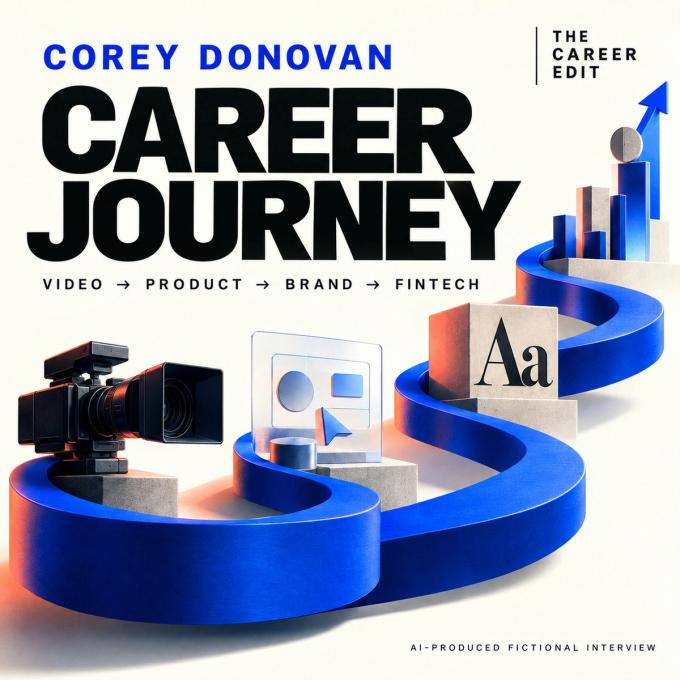
Corey Donovan: From Video to Product, Brand & Fintech
8 min
Corey Donovan traces his career journey from concert films and KPG through Soundstr, Donnova Creative, Pay Theory, Finix, and Tesouro to his current work with AI. A concise fictional interview about the experiences that broadened his practice across product design, brand, marketing, and creative leadership.
AI-produced fictional interview adapted from Corey Donovan’s supplied career accounts and project sources. Scripted dialogue, not a recording of an actual interview.
Open in desktop PodcastsTranscript
The Career Edit Corey Donovan: From Video to Product, Brand & Fintech A career journey from concert films to financial products and AI
AI-produced fictional interview adapted from Corey Donovan’s supplied career accounts and project sources. Scripted dialogue, not a recording of an actual interview.
Scripted, synthesized dialogue; not a recording of a real interview.
HostWelcome to The Career Edit. Today, Corey Donovan traces his career journey from concert filmmaking to product design, brand, and fintech. He's co-founded startups, led creative work at Finix, and designed financial products at Tesouro, alongside his independent practice.
Corey, hello and welcome.
CoreyThanks for having me. Good to be here.
HostHow did making videos become a career?
CoreyI started experimenting with Photoshop and video editing in middle school. In high school, my friend Charlie introduced me to Macs and inspired me to keep making things.
By college, I'd invested in a camera and was approaching bars, nightclubs, and concert venues, offering to make videos for free. Promoters noticed and started inviting me to events. Eventually Mike Posner called and asked me to film his Midwest tour. This was before the tour bus. We were traveling in cars.
Those opportunities helped me build a body of work, but there wasn't much money in it. I needed something sustainable.
HostWhat did KPG add to that foundation?
CoreyI showed them the films I'd been making, and Bob Kelly took me under his wing. I spent about five years there, working in editing and motion graphics for live events and corporate communications.
That's where I developed the craft of storytelling and became much stronger with the Adobe tools. One project involved four screens on robotic arms, with separate videos working as one composition. It meant working with engineers and understanding a different set of constraints.
I also started doing some website work. So the practice was already expanding.
HostHow did you move from that into product design?
CoreyAround 2016, while I was still at KPG, I was developing a concept called Threadster: a curated, shoppable clothing feed. Pitching that idea in Cincinnati's startup community connected me with the people behind Soundstr.
They had a funded business underway and invited me to join as a co-founder. They were working on music recognition, licensing, and royalty transparency. I worked on the brand, website, Pulse portal interface, and the SoundTix ticketing app, alongside video, presentations, and sales materials.
That was the expansion into product and brand. I was embedded in a business, making things people used as well as material explaining what the business did.
HostAnd that broader mix became your own business?
CoreyYes. Donnova began as a video practice, Donnova Studios. The broader Donnova Creative practice grew around those startup years and became more of my focus after Soundstr. Donnova is an anagram of Donovan.
Soundstr had given me experience across interfaces, websites, branding, and business communication. Through Donnova, I could offer that range to other companies. The independent practice continued alongside my later roles, too.
HostWhere did payments enter the picture?
CoreyThrough client work first. I worked on Payments Explorer's website, guides, and HubSpot setup, and the Fintech 513 brand and websites. Finix also became a freelance client.
Then I went to a meeting about a coffee-ordering app. My business could handle the interface design, and I brought a former Soundstr technical colleague to discuss the technology. The conversation shifted into our backgrounds and experience. Those conversations helped lead to Pay Theory.
So I already had payments clients, but Pay Theory was my first payments venture as a co-founder.
HostWhat was your role there?
CoreyChief Design Officer. I worked across product design, brand, and pitch materials. The focus was institutional and education payments: collecting payments, managing accounts, and transaction workflows.
I was there for about a year while continuing freelance work. My Finix relationship was growing during that period. A pitch-deck project became months of close collaboration with their team, and eventually they offered me a position. I accepted and left Pay Theory.
HostAt Finix, where did you spend most of your time?
CoreyMarketing and creative services. Presentations, sales materials, videos, events, and a lot of website work. I maintained the existing site, built landing pages, and coded in HubSpot. Later, I worked on the wireframes and content model for the new website.
The rebrand also developed my creative-direction experience. I hired and managed Kyle Light, who contributed brand design, identity exploration, and illustration. HAUS handled website design and development and helped evolve the digital brand and product storytelling.
We had a marketing team producing content, webinars, and events, and I was involved in the creative around that. The work had expanded considerably from the freelance collateral that started the relationship. I was still making things, but I was also directing work and giving other specialists room to focus.
HostHow did the emphasis change at Tesouro?
CoreyProduct design became the main focus. I joined in 2022 and stayed until August 2026. Early work included acquiring and underwriting portals. Later, a major contribution was an embedded banking and financial-operations platform.
That covered accounts, transfers, cards, capital, invoicing, bill pay, and expenses. The platform was designed to adapt to another company's brand and fit into its software.
I worked with a product lead, a UX colleague, and the wider team on the platform, existing financial workflows, and a design-system overhaul. There were several efforts happening together: designing the new platform, adapting existing financial-workflow designs, and modernizing the system that kept the interfaces consistent. I still contributed to websites, brand, and presentations, but product was the center of the work. That chapter substantially strengthened my product-design capabilities.
HostAnd Donnova continued through those roles?
CoreyYes. My work for LPT and XtraPoint was through Donnova. I served as a fractional marketing leader for LPT and worked across brand, websites, presentations, and marketing materials. I've also managed interns and artists.
I describe myself as a Swiss army knife for businesses. That range suits early-stage companies with a lot to get done. It comes from years of hands-on work across video, motion, product, brand, and websites.
HostWhat are you building on that foundation now?
CoreyAI is changing how I work across those disciplines. I've been using it for websites, including my portfolio, as well as content, video, presentations, and podcasts like this.
With XtraPoint, I've worked on tools and workflows for generating customer-branded marketing materials. At Tesouro, I helped build a custom Claude skill around presentation templates so the CEO could create on-brand executive presentations.
I'm still designing, but I'm not spending as much time doing every part manually. That experience still matters: I've spent years learning to design, code, edit, and work across the software. Now I'm learning how to bring those capabilities into a different way of working. I want to understand how the tools and systems connect, and use them to create useful work for businesses more efficiently.
HostCorey, thank you for taking us through your career journey.
CoreyThanks. I enjoyed it.
HostThis has been The Career Edit.
Download transcriptCredits
Guest: Scripted, AI-voiced Corey Donovan using his existing personal voice clone. Host: Original fictional host, synthesized with ElevenLabs James — Professional British Male. Music: Original AI-generated instrumental theme using ElevenLabs Music v2, reused in a shorter edit. Artwork: Original AI-generated cover using built-in image generation. Writing and editing: Scripted adaptation, editorial production and local audio editing with Codex. Disclosure: AI-produced fictional interview adapted from Corey Donovan’s supplied career accounts and project sources. Scripted dialogue, not a recording of an actual interview. Project collaborators: Project: Finix rebrand and website Name: Kyle Light Contribution: Brand design, identity exploration and illustration. Project: Finix rebrand and website Name: HAUS Contribution: Website design/development, digital brand evolution and product storytelling.